
On August 13, 2014 we saw on our television screens armored vehicles carrying mounted gunners pointing ominously at unarmed grieving people. This militarized presence of police in Ferguson Missouri was there to disperse a grieving community protesting the killing of Michael Brown a young black teenage man about to start college. Eighteen months after the shooting of Michael Brown the Department of Justice filed a civil lawsuit against the city of Ferguson. Yesterday, Attorney General Loretta Lynch said, “Residents of Ferguson have suffered the deprivation of their constitutional rights” and in 2014 we had witnessed a display of this kind of trampling of citizens’ constitutional rights, “of using force without legal justification.”
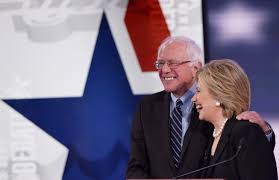 1) The question of the hour for liberal Democrats is the choice. Who will it be? For those living in South Carolina, where the primary is coming up in a few weeks, the decision is imminent.
 Last Sunday we crossed the Ford Street Bridge, three Jewish women in a car with a GPS looking for Mt. Olivet Baptist Church. We were on our way to join a prayer service to celebrate the life and legacy of Dr. King. Our visit would be the second part of a get-together that had begun on Friday at Temple B’rith Kodesh, welcoming the Reverend Rickey Harvey and members of Mt. Olivet Church. Magnificent music had infused our Sabbath service as our two choirs joined. We sang, bodies swaying and hands clapping in the presence of oneness of Jews and African Americans praying without borders and with boundless joy. The service defied histories of divisions, refused acrimonies and produced a “we the people.”
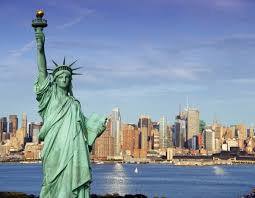 It is not easy to cede the moral high ground to one Donald Trump, but Ted Cruz accomplished this remarkable feat by accusing his rival for the Republican presidential nomination of being an incarnation of “New York values”—“I think most people know exactly what New York values are: socially liberal, pro gay-marriage, pro-abortion, focused on money and the media.” Trump, in response, knocked Cruz’s crude slurs out of the park, speaking of 9/11 and the subsequent rebuilding.
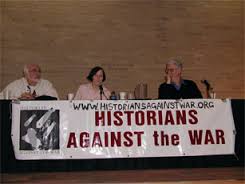 Over the weekend, I attended the American Historical Association (AHA) annual convention in Atlanta. Historians, as a rule, are not a particularly raucous bunch, and the 3,500 or so historians generally went about their business quietly, delivering papers, buying books, trying to cadge free food at various receptions, and the like. But there was one exciting moment. At the business meeting, there was a vote on a resolution introduced by an organization called Historians Against the War (HAW)condemning Israeli interference with higher education and academic freedom on the West Bank and Gaza, and calling on the AHA to monitor Israel’s behavior. This resolution was tailored to garner as much support as possible, and unlike earlier resolutions introduced by HAW, it did not explicitly call for a boycott of Israeli academic institutions. Still, it was an attempt to get the AHA on record against Israel’s educational policies, and perhaps use it as a toehold from which to launch stronger BDS resolutions.